
If you’re new to reading the Bible, you may find yourself overwhelmed by things Christians recommend to you – like reading plans; or you may feel utterly swamped by the number of choices of Bibles to read, or so out of your depth that you need a “Bible for Beginners”. You may question if you should read it from cover to cover, or if you need to read the entire Bible or just portions of it?
You may even feel like giving up before you even start reading!

My name is Scott, I’m part of the Glasgow Church of Christ located in central Scotland, and I want to share a few useful tips to help you understand how to read the bible effectively so that you can get the most out of God’s Word.
When we sit down to do some Bible reading or study, there are a few things to keep in mind which might help us to get the most out of our reading experience or Bible study session. The Bible isn’t a “normal” book. It isn’t even a book – it is a library of sixty-six ancient texts which are called books, and, when taken together, they form a complete narrative.
The documents contained within the Bible were written over a period of a few thousand years by around forty different authors from different cultures and backgrounds, and as such it does not necessarily read the same way that a twenty-first-century novel would.
The Bible needs to be interpreted the right way in order for us to understand what it is saying. You may hear people say, “I don’t interpret the Bible – I just let it speak for itself!”. However, the truth is that everyone interprets the Bible, whether they are aware of it or not, and interpretation is not a bad thing in and of itself. Let’s take a look at ways that the Bible is interpreted.
Translation – How To Read The Bible
For starters, parts of the Bible were written in the ancient Hebrew language and other parts were written in the ancient Greek language.
So any Bible that we happen to be reading which isn’t in those languages has already been interpreted by the translator in order for them to deliver to you what they have read. There is very rarely a word which can only be translated into one other word in another language – usually, there are a good handful of different words in one language which could be used to describe one word in another.
Or the opposite can be true, where there is only one word available in one language which has to be used to translate several different words in another language – did you know that the ancient Greek of the New Testament uses six different words for “love”, which each show a different aspect from each other (romantic or sexual; for everyone; for self; deep friendship; playful; longstanding), but the English language only has a single word to use (“love”) when each one of these different words appears.
There are three main groups or types of Bible verions translation, although some versions can be a blend of these:
Word-For-Word (Formal) Translations:
Word-For-Word (Formal) translations are where the translator has done their best to preserve the accuracy of the specific words used in the original text, even if the meaning of the phrase may be lost to readers of different languages – if, for instance, the writer has used a figure of speech which doesn’t translate well into another language (“it was raining cats and dogs”, would be left as it is even if the person reading may be left with the impression that feline and canine animals were falling from the sky), or a unit of measurement which is not in use today (“cubits” and “ephahs”, rather than metres and litres). Word-For-Word is very useful for times of deep study, and when the reader already understands the background setting of the literature well.
The English Standard Version (ESV) is a Word-For-Word Bible.
Thought-For-Thought (Dynamic) Translations:
Thought-For-Thought (Dynamic) translations move on from the Word-For-Word stage and seek to clean up the text a bit by the translator choosing to insert the equivalent meaning of the phrases translated, rather than what the original text literally said. Figures of speech would be written as what they mean (“it was raining cats and dogs” could be rendered “it was raining very heavily”), and units of measurement may be given as an equivalent which is in use today (for example, a denarius was a coin used in the first century which was worth one day’s wage, so “he gave each of them a denarius” could be written as “he gave each of them one day’s wage”). Thought-For-Thought is useful for studying and reading.
The New International Version (NIV) is a Thought-For-Thought Bible.
Paraphrase Translations:
Paraphrase translations are where the translator has moved on from the Though-For-Thought stage and has rearranged and rewritten parts of the text in order to make the text read or flow better for the audience. Where a Word-For-Word could say, “Sam struck Ben with his hand, and Ben became unconscious”, and a Thought-For-Thought could say, “Sam punched Ben, and knocked him out”, a Paraphrase translation could say, “Ben was out for the count after Sam whacked him real good!”. Paraphrase is useful for personal devotion, reading for enjoyment, and hearing scriptures from different points of view.
The Message (MSG) and The New Living Translation (NLT) are both Paraphrases.
Below is a table showing common English versions of the Bible and where they fit on the scale from Word-For-Word to Paraphrase.

Exegesis & Hermeneutics – How To Read The Bible
The two ways to approach interpretation are called “Exegesis” and “Hermeneutics”. Exegesis is to do with the “there and then” – figuring out what the text is literally saying, and what message the text had when it was written. Hermeneutics is figuring out the “here and now” – what relevance the passage has and what it’s implications are today.
Exegesis covers the context of a passage. A major aspect of this is the socio-historical context – where it was written, when it was written, what the culture of where it was written was like, and what the culture of who it was written to was like. We don’t just focus on dates, settings and people who were around at the time, but prevalent ideas and concepts that dominated the “thinking” of the day are very important. In the Old Testament, we find the concept of Ancient-Near-Eastern polytheism (worship of many gods in the ancient near and middle East) coming into conflict with the Hebrew Monotheism (worship of a single God who is supreme), and in the New Testament, there is a common theme of the divide between Jews and Gentiles and how this affected the early Christian communities.
There are many good resources and materials available to help you dig into the socio-historical context – have a look at some Bible dictionaries/encyclopedias, historical commentaries/surveys, archaeological reviews, focused study bibles (different from “devotional” bibles), video documentaries and lectures, Bible commentaries.
Another aspect of exegesis is the literary context – what genre of literature the passage is. The Bible contains sixty-six texts which range in style of literature – historical writing, poetry, epistle, gospel, legal texts / administrative records, liturgy, prophetic, apocalyptic writing, wisdom literature, parables, and cosmogony… and sometimes the author may use different genres within a single book! Our understanding and interpretation of scripture must take the genre into account, especially as when we know what genre we are reading then this can alert us to whether the author may be using figurative or literal language.
For instance, the Psalms are a collection of poems which regularly feature the use of poetic devices such as metaphors and similes, which should not be taken as literally true as this is figurative language. If we were to take the physical descriptions of God in Psalm 18 as being literally true and tried to draw him as described, then we would end up creating a picture of a creature who was: a rock, a fortress, a shield, and a horn (verse 2); having ears (verse 6), nostrils that produce smoke, a mouth that spits fire and coals (verse 8), feet (v9), and a voice producing the sound of thunder with hailstones and coals of fire (v13); who rides on a cherub (v10), and on the wings of the wind (v10, also, does the wind really have wings?); and wears darkness as a cloak (v11). This would make no sense and would be an abuse of the text because the writer is using word imagery to tell us about the character and nature of God, and they are not literally describing things they have seen. So, when we look into the setting of a passage, we get a better idea of what the author intended to say to their original audience. And always remember that a text cannot mean something today that it did not mean to the original audience.
Hermeneutics covers the relevance of passages. It helps us to understand what is written for us rather than to us. The Bible covers different periods of time which went along with, to some extent, different expectations of the follower of God, as there were two main covenants between people and God at different times, which differ greatly from each other. Some commands written in the Old Testament and the New Testament are not applicable to us today; some commands are only applicable to the Old Testament, and some things are only applicable to the New; and a lot of it is very much applicable to us today. What was the Word of God to the audience of the passage, is also God’s Word to us in genuinely comparable situations.
When we look into the background of the passages through exegesis and apply reasonable hermeneutics to what we learn, the Bible can be understood as simply as possible in order for us to gain the richest insight.
Prophecy is the only genre that can break the Exegesis & Hermeneutics rules, as we understand that there was a deeper meaning embedded in the prophecies which is seen more fully and completely only after the prophecy had come to pass. However, only prophets had the ability to do this, as God anointed them with the visions and words through the Holy Spirit – it was not a skill that someone could learn!

The Basic Applications – How To Read The Bible
Part of good Hermeneutics is recognising how to apply scriptures, which can be broken into four basic categories:
- Theological Truths: A statement describing reality in such a way that it’s considered universal truth – “Jesus is Lord”, Acts 2:36, Philippians 2:9-12, Hebrews 13:8, etc.
- Commands: A direct instruction on how to think or behave – “Love each other”, Mark 12:33, Matthew 5:44, John 13:34-35, Romans 12:10, Galatians 5:13-14, 1 John 4:7-8, etc.
- Principles: A general rule applied in different situations. Key question: how similar is their situation to my situation in applying the principle? For instance, Romans 13-14 and 1 Corinthians 10 – should I eat food offered to idols? My answer depends on how my situation compares to the principles in these passages of “being conscious of conscience”, and “do not cause another to stumble”.
- Patterns / Precedents: An activity repeated in such a way as to establish continuity and custom. Key questions: is there actually a pattern (Mark 1:35)? Does the pattern establish a binding precedent (Acts 2:38-39)?
Exegesis & Hermeneutics In Action
A general workflow for Exegesis and Hermeneutics can be followed thus:
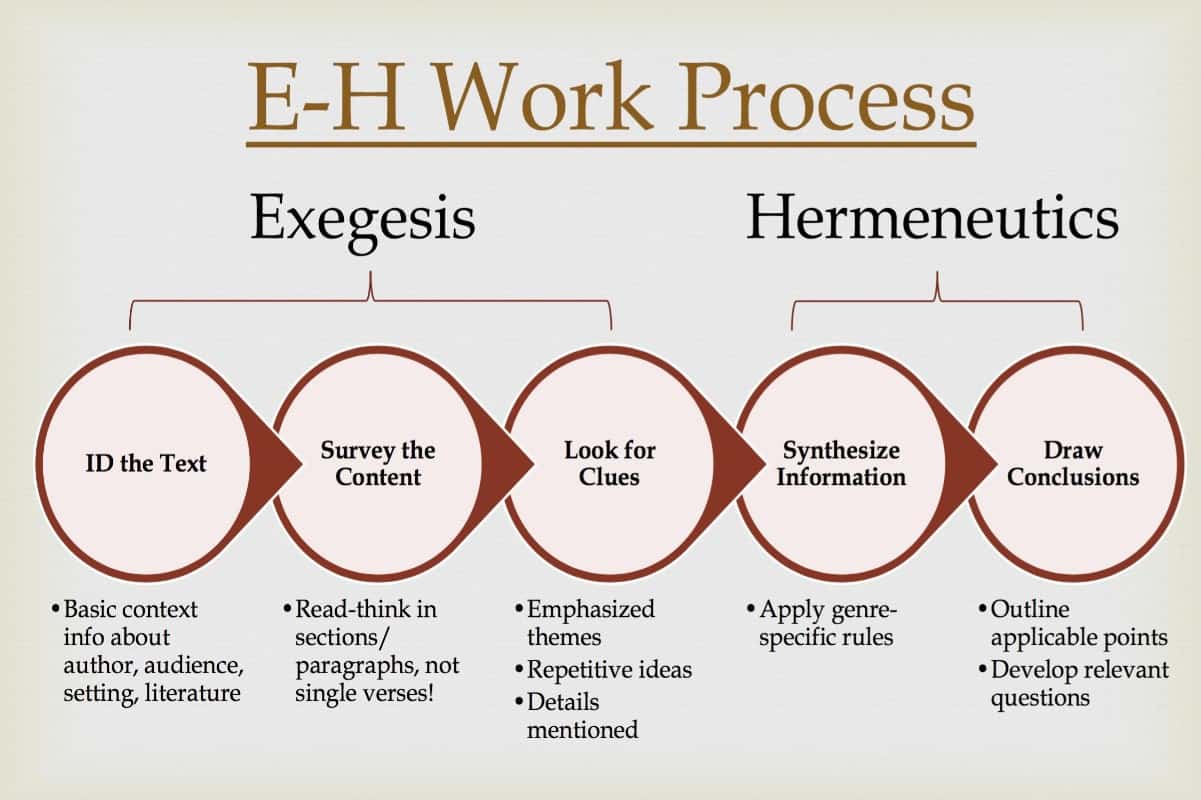
Here’s an example of how to apply this workflow, using the passage Luke 8:43-48 and taking notes:
ID The Text
- The passage is from one of the gospels – a gospel is a document which covers events in Jesus’ life from his birth to death and resurrection. These typically focus on Jesus’ ministry and mission in the period around 30 AD in Judea/Israel, when they were occupied by the Roman Empire.
- The passage is a narrative section of the gospel that tells miracle stories that illustrate the power of Jesus Christ.
- The overall aim of the author is to tell me something important about Jesus.
Survey The Content
- This episode is 1 of 4 miracle episodes recorded successively in Luke 8:22-59.
- This episode appears to be its own subsection of these miracles.
Look For Clues – Overview
- All 4 episodes have a common theme of “fear versus faith”.
- The passage specifically mentions the woman had been bleeding for 12 years.
- The crowd was pressing in around Jesus.
- She touches the edge of Jesus’ cloak.
- Jesus calls her, “Daughter”.
Look For Clues – Detail
- Bleeding for 12 years – the woman is “ceremonially unclean” and would be required by law to live in quarantine or to publicly announce her “uncleanness” to others when she leaves her house.
- Pressed in the crowd – relating to the previous point, the woman would have made everyone around her “unclean” as well if they touched her, which would be difficult to avoid in such a situation.
- Edge of cloak – in this culture, there would be tassels on the edge of garments which symbolised the wearer’s ritual purity and devotion to God, so this was the “holiest” place on his clothes which she could touch.
- Daughter – this is a term of familial affection, commitment and protection.
Synthesise Information
- The narrative has a teaching point about Christ: faith over fear.
- The woman is desperate, living in shame, isolation and insecurity before people and God. The social taboos of uncleanness were a BIG deal for Jews at this time.
- The woman took a big risk being in the crowd – were the crowd to find out about her personal circumstances then they would likely turn on her.
- Touching the tassel is bold and ironic – the ritually unclean woman touched the part of the holy teacher that symbolised his purity.
- The woman was trembling and trying not to be noticed – if she had been “outed” she could incur the wrath of crowd, and of Jesus himself!
- Jesus turned the situation on its head – instead of dealing her wrath, anger, shame and rejection – he calls her “daughter”. She was physically restored, and her self-worth was restored too. Jesus signalled to the crowd that she was now clean and accepted (and protected).
Apply Conclusions
- There are no specifically applicable commands mentioned here, or patterns developed from this passage. There are points of theological truth and, perhaps, principles to mention.
- Jesus’s compassion transcends ritual and/or popular taboos.
- No one is too unclean to come to Jesus – we can’t make him dirty, he is the one who makes us clean!
- Our personal fears about what people might think about our “secrets” can be overcome by faith in Christ. God already knows everything about us, and is on our side, willing us to acknowledge our brokenness and to let him make us whole.
- When we come to Christ, the Bible generally teaches that we become “sons and daughters” of God, which is very encouraging though – God loves us affectionately, with a strong commitment to us and our protection!
Personal Tips
Here are some pointers that I find useful for my personal reading of the Bible:
- Begin with a prayer – I ask God to grant me wisdom and understanding for me to get to know his heart better, to know who he is better so that I can find who I was created to be.
- Make it interactive – I try to read as if God, or Jesus, is telling me his story.
- Try reading out loud – by speaking the Bible, it helps me to better grasp the impact and emotion of it.
- Ask questions – if I come across sections, phrases, or ideas that I don’t understand, I write these down and ask someone about it later. If you don’t know anyone personally who you can ask about the Bible, why not head along to a local church and ask somebody there? Christians love to talk about the Bible, especially with people who genuinely want to understand it better, so don’t be shy!
I hope you have enjoyed this article on How to Read the Bible and Get the Most Out Of It and I look forwards to meeting you in one of our Bible study groups sometime soon.